Preamps are, first and foremost, devices for controlling volume. 99%+ of all preamps do this by throttling the audio signal through some type of mechanical device made with resistive materials. Devices like a potentiometer (worst) or stepped attenuator (better). The unfortunate reality is the materials in these devices, together with their mechanical interface points, alter the audio signal in ways that are not benign. Let’s speak more plainly – they suck at conducting music.
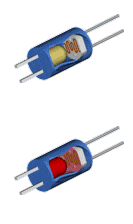
Tortuga Audio uses light dependent resistors (LDRs) to control volume. The conductive material in LDRs is amazingly kind to the audio signal. The difference is undeniably audible. LDRs are more articulate. LDRs are more open. LDRs are more neutral.
Simply put, LDRs are better conductors of music.
2 – Lower Noise Floor
A passive preamp has an inherently lower noise floor compared to most any active preamp. A lower noise floor means a quieter darker background between notes. This adds more dynamic range to the music and creates a more interesting and engaging listening experience.
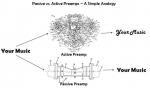
Passive preamps have a lower noise floor because they don’t use a power supply to actively alter (amplify and/or buffer) the audio signal. All power supplies impart noise on an audio signal.
Why add noise if you don’t need to?
3 – Lack of Coloration
Every component in the audio signal chain imparts its own coloration to the sound; passive preamps much less so than active preamps.
LDR passive preamps are THE most neutral sounding preamp available and are essentially without coloration.
The question comes down to: Do you want to listen to your music or to your hardware?
4 – You Don’t Need The Gain
Long ago and far away there was a time and place when most audio sources had weak outputs and amps were mostly low powered. To make up for this preamplifiers were designed to actively boost the voltage level of the audio signal to achieve sufficient loudness. This boost is referred to as “gain”.
Today, it’s rare that you need to actually pre-amplify the audio signal. Adding a gain stage when you don’t need one inevitably degrades the audio signal and puts greater distance between the true sound of the recording and what you hear coming out of your stereo.
Why pre-amplify before your amplify? Think about it.
5 – Costs Less
Active preamps require quite a bit of hardware? What hardware? Capacitors, resistors, diodes, op amps, tubes, transformers the list goes on. Your music has to get through all of that…stuff. And all that stuff costs manufacturers more money to both procure and to assemble.
Thus, not surprisingly, most high performance active preamps cost thousands of dollars more and yet don’t out-perform LDR passive preamps.
With LDR passive preamps, less is indeed more.
6 – BONUS REASON!
Are you an iconoclast? Do you enjoy overturning the apple cart with new found information that challenges existing assumptions? If so, then you’re in for a treat.
Ask most any informed audiophile and chances are quite good they will tell you that passive preamps simply do not measure up to high end performance standards and that you’d better stick with a conventional active preamp.
Once you have your Tortuga passive running and broken in, go ahead and invite your audiophile friends over for a listen. Make sure to tell them it’s “just a passive”. And then watch their faces as they listen to how good your system sounds. Priceless!
[FYI, no pigs were harmed in authoring this article. 🙂 ]
The debate over passive vs. active preamps mushes on within the audio community with the prevailing wisdom being that an active preamp is better than any/all passive preamps. Is this really true? As with so many things in life the answer is….it depends.
While chatting recently with a customer (which I love doing BTW) he mentioned that he would be attending Axpona in Chicago and asked if Tortuga Audio would also be at the show. I told him that, unfortunately, circumstances prevented Tortuga Audio from being at Axpona this year. He suggested that in that case he might…
When Ron Brenay of NewRecordDay.com visited our room at RMAF14 he discovered he really didn’t want to leave. Why? Because he was having such a good time listening to music on our system. He was sufficiently impressed that he asked if I’d do a video interview and although I’m camera shy to a fault I…
LDR3: Based on input from current and prospective customers, we are retiring the LDR1 effective immediately and replacing it with the LDR3. The LDR3 is our “Goldilocks” passive preamp. Not too few inputs like the LDR1 and not too many like the LDR6. Just right with 3 inputs & 2 outputs. Pricing: We are pleased…
What Is This Notice About? Since initial release of the ldr3x.V2 board we’ve been actively evaluating how auto-calibration is set up on the V2 board with the help of feedback from our V2 customers and even input from prospective customers. As a result of this work, we are making some changes to auto-calibration. Also, we…
LDR3.V2 Passive Preamp Awarded Tortuga Audio is pleased to announce that its LDR3.V2 Passive Preamp has made the list of The Absolute Sound’s Editors’ Choice Awards for 2016. Details regarding the Editors’ Choice Awards will be made available in the March issue of The Absolute Sound which is scheduled to be mailed out on January…